India, on Friday the 26th June 2027, launched ‘Operation Amistad’, dispatching a specialised paratrooper medical contingent to earthquake-stricken Venezuela.
News from the affected areas speak of frantic search operations for survivors beneath collapsed buildings and rubble.
When last reports came-in, the death toll from the Latin American nation’s worst natural disaster in decades climbed above 235.
In a swift humanitarian response, New Delhi on Friday sent a 41-member Indian Army medical team from the 60 Para Field Hospital to support relief operations in northern Venezuela, where twin powerful earthquakes have left thousands injured and tens of thousands homeless.
“‘Compartimos su dolor. Estamos con ustedes’ (We share your pain. We stand with you),” India’s Ministry of External Affairs said in a statement announcing the mission.
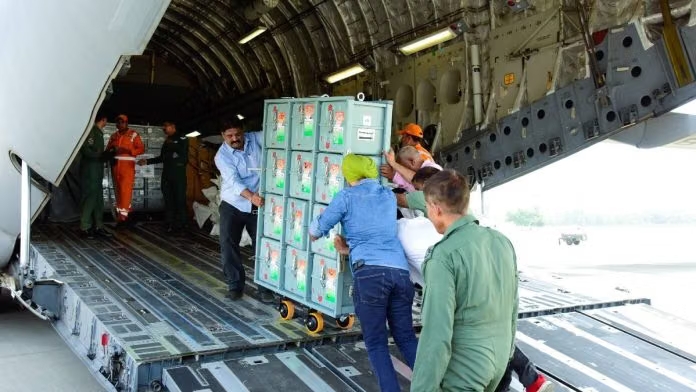
The contingent, comprising nine medical officers and specialised support staff, departed aboard two Indian Air Force C-17 aircraft carrying nearly six tonnes of medical supplies and humanitarian assistance.
The deployment includes the indigenously developed ‘Bhishm Cube’ under India’s Aarogya Maitri initiative, a rapidly deployable modular field hospital capable of treating up to 200 patients and providing advanced trauma care, emergency surgery and intensive care support.
The mission comes as Venezuelan authorities struggle to cope with the scale of destruction caused by two major earthquakes that struck the country’s northern region, on Wednesday night (local time), less than a minute apart.
The Venezuelan Health Minister Carlos Alvarado said at least 235 people had died and more than 4,300 had been injured, warning that casualty figures could rise further as rescue teams reached devastated communities.
“We’ve unfortunately received about 235 patients who arrived without vital signs at our health centres,” Alvarado was quoted in the told local media in Caracas.
According to the United States Geological Survey, a magnitude 7.2 earthquake struck approximately 160 kilometres west of Caracas, followed moments later by a stronger magnitude 7.5 tremor.
Entire residential blocks collapsed across affected areas, trapping residents beneath concrete and twisted steel.
Rescue workers, aided by sniffer dogs, heavy machinery and volunteers, continued digging through rubble on Friday in a race against time to locate survivors.
Officials declined to estimate the number of people still missing, although fears remain that hundreds could be trapped.
“The first 24 to 72 hours are crucial. Most of those who can be saved have to be found within this time frame. Though miracles have happened in the past and people have come out above even after a week,” said Indian doctors who have earlier participated in earthquake and mine collapse rescues.
The disaster has forced tens of thousands from their homes. Across Caracas and neighbouring towns, public parks, sports grounds and streets have been transformed into makeshift shelters as residents avoid damaged buildings amid concerns over aftershocks.
The earthquakes were felt across a wide swathe of northern South America, with tremors reported as far away as Brazil’s Amazon region.
Significant damage was also reported to transport and public infrastructure, including Simón Bolívar International Airport near Caracas, which has suspended operations pending structural inspections.
Schools have been closed nationwide, with several educational facilities converted into temporary shelters and aid distribution centres.
India’s intervention underscores its growing role as a first responder to international humanitarian crises.
Besides the Venenzuelan army and disaster control personnel, the main help has come from the United states which has sent a major general to direct rescue and relief operations being done by its Marine corps.
Neighbouring Mexico has similarly sent a rescue mission to join in the efforts and help Venezuela in its hour of need.
The deployment follows similar disaster-relief operations undertaken by New Delhi in Türkiye, Nepal and Myanmar, reflecting a foreign policy increasingly centred on humanitarian assistance and disaster relief capabilities.
Officials described Operation Amistad as an expression of India’s long-standing commitment to the principle of Vasudhaiva Kutumbakam — “The World is One Family” and a demonstration of solidarity with the Venezuelan people at a moment of profound national tragedy.