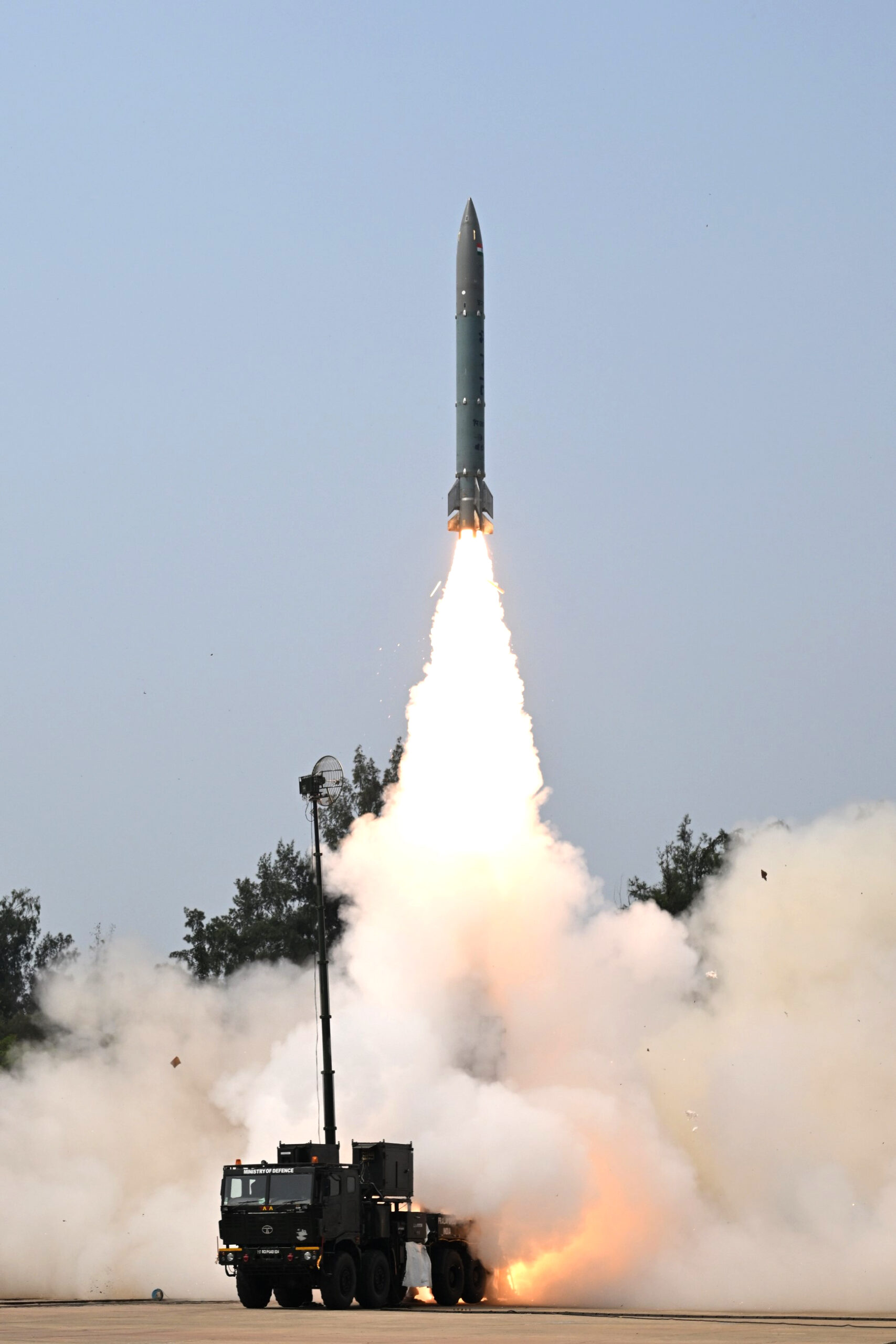
The Defence Research and Development Organisation (DRDO) on Thursday successfully conducted a flight test of the indigenously developed Pralay missile from Dr APJ Abdul Kalam Island off the coast of Odisha, marking a major step towards the weapon system’s operational induction into the armed forces.
The Ministry of Defence said the quasi-ballistic surface-to-surface missile successfully met all mission objectives during the test. Performance parameters were validated through data captured by a network of tracking sensors and range instrumentation deployed by the Integrated Test Range (ITR) at Chandipur.
The trial was conducted in the presence of senior DRDO scientists, representatives of the defence industry and officials from the armed forces as part of ongoing user evaluation trials. Defence officials said the successful test further validates the missile’s operational capabilities and strengthens its case for induction.
Developed by Hyderabad-based Research Centre Imarat (RCI) in collaboration with several other DRDO laboratories, Pralay is one of India’s most advanced conventional tactical missile systems. The missile is designed to fill a critical capability gap between long-range rocket artillery systems and strategic ballistic missiles, providing commanders with a rapid, highly accurate conventional strike option against high-value targets.
Named after the Sanskrit word Pralay, meaning destruction or apocalypse, the missile is powered by a solid-fuel rocket motor and follows a quasi-ballistic trajectory. Unlike traditional ballistic missiles, Pralay can perform terminal manoeuvres and alter its flight path during the final stages of flight, making interception by enemy missile defence systems significantly more challenging.
The missile has an operational strike range of approximately 150 to 500 kilometres, enabling engagement of targets deep inside hostile territory while remaining within conventional battlefield requirements. It is capable of carrying conventional warheads weighing between 350 kilograms and 1,000 kilograms, depending on mission requirements.
Pralay’s payload options include high-explosive pre-fragmented warheads, penetration-cum-blast warheads for hardened structures, and runway-denial submunitions intended to cripple enemy airbases and operational infrastructure.
These capabilities enable the missile to strike a wide range of military targets, including command-and-control centres, radar installations, communication hubs, ammunition dumps, logistics nodes, fuel depots, bridges, airfields and other critical military infrastructure.
The missile incorporates a sophisticated guidance package combining an advanced Inertial Navigation System (INS) with satellite-aided navigation updates to ensure high levels of precision. DRDO officials have previously indicated that the system is capable of achieving a Circular Error Probable (CEP) of less than 10 metres, giving it the accuracy required for precision engagement of high-value targets.
Pralay is also reported to feature advanced terminal guidance technologies, including Digital Scene Matching Area Correlation (DSMAC) and radio-frequency seeker-based targeting, allowing improved accuracy against fixed and semi-mobile targets even in contested electronic warfare environments.

Travelling at supersonic speeds throughout much of its flight profile, the missile can reportedly achieve terminal velocities exceeding Mach 6, reducing enemy reaction time and increasing the probability of successful target engagement.
Military planners view Pralay as a key component of India’s evolving conventional deterrence architecture, particularly along the northern and western fronts. The missile is often compared with tactical battlefield missile systems such as China’s DF-12 and Russia’s Iskander, although Pralay has been developed entirely through indigenous technology and production capabilities.
The missile is being produced by Bharat Dynamics Limited (BDL), with both the Indian Army and the Indian Air Force having approved acquisition plans. Once inducted, Pralay is expected to become a frontline precision-strike weapon capable of neutralising enemy airbases, integrated air-defence systems, logistics centres and strategic military infrastructure in the opening stages of a conflict.
Defence officials believe the system will eventually form part of India’s expanding long-range precision strike inventory alongside indigenous missile and rocket systems such as the BrahMos, Pinaka and Prahar family of weapons.
The latest successful user trial is expected to accelerate the path towards full operational deployment, bringing India closer to fielding a highly accurate, indigenous conventional missile capable of delivering rapid and survivable strikes against heavily defended targets