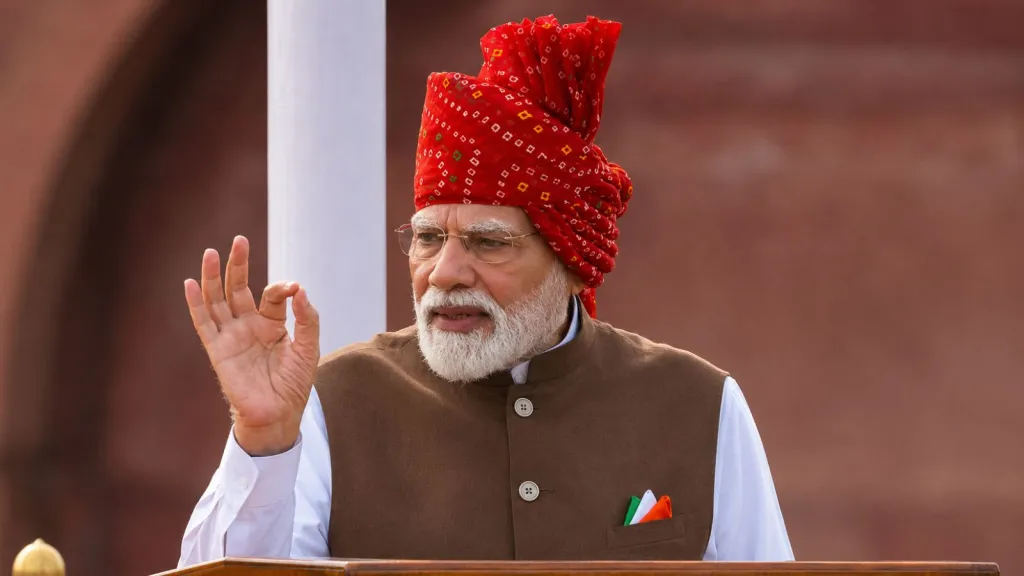
In his inimitable and distinctly prime ministerial address as India’s leader, Prime Minister Narendra Modi led the nation in celebrating its 80th Independence Day.
Delivering his speech from the ramparts of the Red Fort, the Prime Minister highlighted his vision of seven streams—the Saptadhara—aimed at achieving holistic national development and self-reliance. These streams encompass manufacturing excellence focusing on ‘cost, quality, and scale’; farming and food processing; technological innovation; Gati Shakti connectivity; defence self-reliance; a push toward green and blue economies; and global soft power driven by the spread of yoga, healthcare, tourism, and the creative arts.
Modi directly addressed the nation’s youth, stating they will play a crucial role in these reforms. He also announced a nationwide talent hunt to train children aged 5 to 15 for the 2036 Olympics. For this historic address, Modi sported a bright red turban featuring a yellow, green, and white Rajasthani Bandhani pattern. Before arriving at the Red Fort, the PM paid floral tributes to the Father of the Nation, Mahatma Gandhi, at Rajghat.
This year’s celebrations at the Red Fort featured a historic first: a full rendering of the National Song, Vande Mataram, preceding the customary singing of the National Anthem, Jana Gana Mana. Notably, 2026 marks 150 years since Vande Mataram was penned.
As a major highlight of his 76-minute speech, Modi urged the country’s youth to identify and isolate “dimagi Naxals” (intellectual Naxalites) and focus their energy on nation-building rather than leading society down the wrong path.
Elaborating on his concept and thought process behind the ‘seven streams’, Modi said, “From design to manufacturing, India must become a reliable hub in the global supply chain. For this, I want to place special emphasis on three things. My brothers and sisters in the field of manufacturing, do not let this opportunity slip away. To capitalize on this, we must meet global standards on cost, quality, and scale.”
“The second strength of Saptadhara is agriculture and food processing. We must move forward in this direction. The world’s markets are now open to our farmers. Through Free Trade Agreements (FTAs), we are gaining access to vast new markets, and we must reach them. We must transition from local farming to the export market. Our traditional cuisine, millets, spices, fruits, and flowers should become global brands,” he said.
He described the third strength as technology and innovation.
“Today is the era of AI, quantum technology, space, robotics, and data centres. Emerging technologies present new challenges every moment, and we must become a global hub of innovation. We have already proven our mettle through UPI and digital public infrastructure. Now, India must take these digital public technologies to every corner of the world. We must lead in next-generation communication technology, and our goal should be for ‘Made in India’ 6G to reach every corner of the globe,” he added.
On the fourth pillar, PM Modi emphasized that Gati Shakti must focus on seamless, high-speed connectivity and port-led development.
“We need seamless high-speed rail connectivity, modern highways, inland waterways, airports, multi-modal logistics hubs, and ports. Our cities must be connected through high-speed rail, and we have to work aggressively towards port-led development,” the PM stated.
PM Modi concluded by identifying defence production as the fifth strength of Saptadhara, asserting that India must become self-reliant and aim to be a global supplier in this sector.
“The second strength of Saptadhara is agriculture and food processing. We must move forward in this direction. The world’s markets are now open to our farmers. Through Free Trade Agreements (FTAs), we are gaining access to vast new markets, and we must reach them. We must transition from local farming to the export market. Our traditional cuisine, millets, spices, fruits, and flowers should become global brands,” he said.
He described the third strength as technology and innovation.
“Today is the era of AI, quantum technology, space, robotics, and data centres. Emerging technologies present new challenges every moment, and we must become a global hub of innovation. We have already proven our mettle through UPI and digital public infrastructure. Now, India must take these digital public technologies to every corner of the world. We must lead in next-generation communication technology, and our goal should be for ‘Made in India’ 6G to reach every corner of the globe,” he added.
On the fourth pillar, PM Modi emphasized that Gati Shakti must focus on seamless, high-speed connectivity and port-led development.
“We need seamless high-speed rail connectivity, modern highways, inland waterways, airports, multi-modal logistics hubs, and ports. Our cities must be connected through high-speed rail, and we have to work aggressively towards port-led development,” the PM stated.
PM Modi concluded by identifying defence production as the fifth strength of Saptadhara, asserting that India must become self-reliant and aim to be a global supplier in this sector.
Describing green energy as the sixth strength of ‘Saptadhara’, the Prime Minister called for greater innovation in the sector.
“India must achieve global leadership in green hydrogen, renewable energy, and energy storage, while continuing to provide solutions to global challenges. The Blue Economy also offers immense opportunities in fisheries, coastal tourism, and ocean technology, opening new pathways for India’s growth,” he said.
The Prime Minister added, “We must work in the areas of renewable energy, energy storage, green storage, and manufacturing. India has a massive opportunity in the Blue Economy.”
Modi stated that India’s ‘soft power’ is the seventh strength of Saptadhara, highlighting Yoga, handicrafts, films, animation, gaming, digital content, and the broader creative sector as key assets.
“Today, Yoga has connected the world to India. Our Ayurveda, holistic healthcare, handicrafts, culture, films, animation, gaming, and digital content are gaining global recognition. The world is looking forward to India’s WAVES summit. With more than 100 national parks, we have a unique opportunity to attract foreign tourists through the strength of our soft power,” he said.
The hoisting of the Tricolour at the Red Fort was synchronised with a 21-Gun Salute by the gunners of the 1721 Field Battery (Ceremonial).
The ceremonial battery used indigenous 105mm Light Field Guns and was commanded by Major Pawan Singh Shekhawat, while Naib Subedar (Assistant Instructor in Gunnery) Anuthosh Sarkar served as the Gun Position Officer.