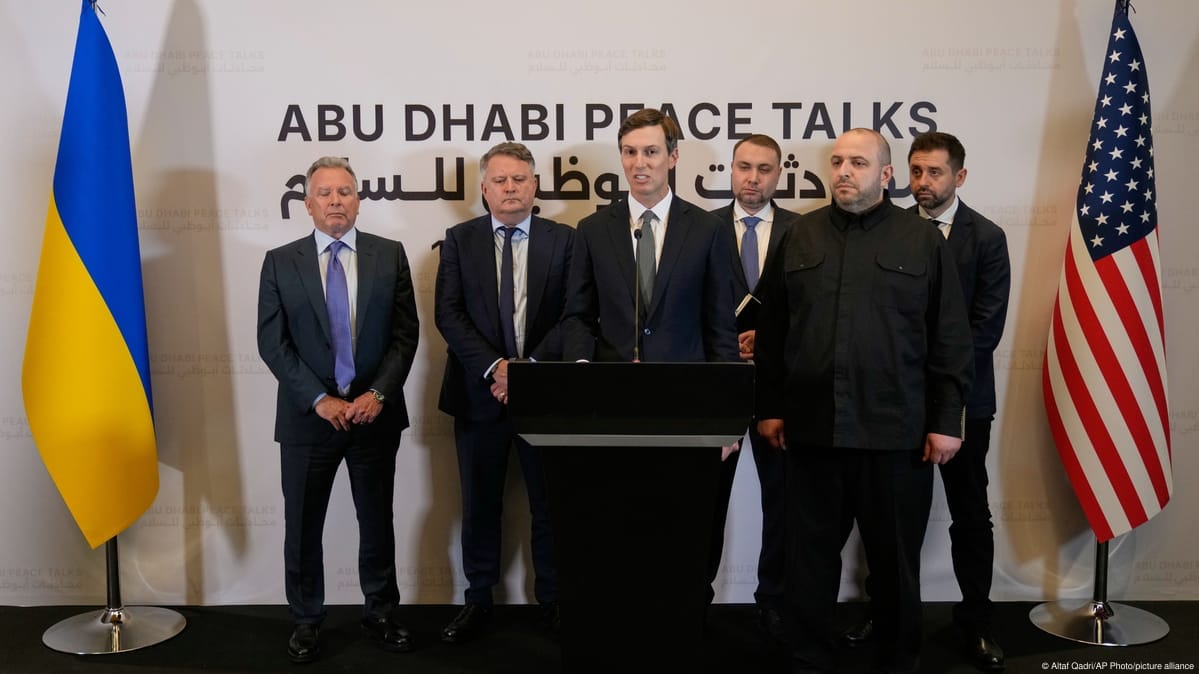
A renewed international effort to end the Russia-Ukraine war has yielded its first significant breakthrough, with Moscow and Kyiv agreeing in principle to a major prisoner-of-war exchange following two days of US-mediated talks in Abu Dhabi.
While the negotiations stopped short of producing a ceasefire or a broader political settlement, the proposed exchange is being viewed as the most concrete outcome to emerge from recent diplomatic efforts and a rare point of agreement between the two sides after nearly five years of conflict.
The agreement came at the end of intensive discussions facilitated by senior US envoys Steve Witkoff and Jared Kushner, who described the talks as difficult but productive.
The two American representatives are now expected to travel to Moscow for discussions with Russian President Vladimir Putin before meeting Ukrainian President Volodymyr Zelenskyy in the next phase of Washington’s diplomatic initiative.
The prisoner-swap proposal, which officials say could become the largest of the war, is being seen as an important humanitarian gesture as well as a potential confidence-building measure.
Diplomats hope it could create a more constructive atmosphere for future negotiations on the far more complex issues that continue to divide Moscow and Kyiv.
The Abu Dhabi talks underscored both the possibilities and limitations of the current diplomatic process.
On one hand, they demonstrated that channels of communication remain open and that progress is still possible on specific humanitarian matters.
On the other, they highlighted the deep differences that continue to stand in the way of a comprehensive peace agreement.
Among the most contentious issues is the future format of negotiations.
Ukraine has maintained that European countries must be directly involved in any discussions that will shape the continent’s future security architecture.
Kyiv argues that decisions affecting Europe’s long-term stability cannot be taken solely through a framework involving the United States, Russia and Ukraine.
Several European governments have echoed that position, insisting that any lasting settlement must include those who will be directly affected by its consequences.
Russia, however, has expressed reservations about a larger negotiating format.
Moscow has argued that nations providing military and financial assistance to Ukraine cannot be considered neutral participants in peace talks, reflecting a broader disagreement over how future negotiations should be structured.
The debate over participation comes as the sides remain divided on a range of core issues, including territorial disputes, security guarantees, sanctions, military deployments and Ukraine’s future relationship with NATO.
Those questions have repeatedly complicated diplomatic initiatives since the war began and remain the principal obstacles to any eventual settlement.
Nevertheless, the latest talks have injected fresh momentum into a peace effort that many observers feared had stalled.
The decision by Washington’s envoys to engage directly with both Putin and Zelenskyy in the coming days suggests that the United States believes there is still room for movement despite the entrenched positions of the warring parties.
Diplomatic observers caution that expectations should remain measured.
Previous attempts to broker agreements have often produced temporary openings without leading to lasting political solutions.
Yet the prisoner-exchange understanding has given negotiators something that has been largely absent in recent months: a tangible achievement that both sides can point to as evidence that dialogue remains worthwhile.
Whether that humanitarian breakthrough can evolve into a broader political process will depend largely on the discussions that now move from Abu Dhabi to Moscow and Kyiv.
For now, the talks have not brought peace any closer. But they have produced the first meaningful sign in months that diplomacy may still have a role to play in ending Europe’s longest and most consequential conflict in decades.