
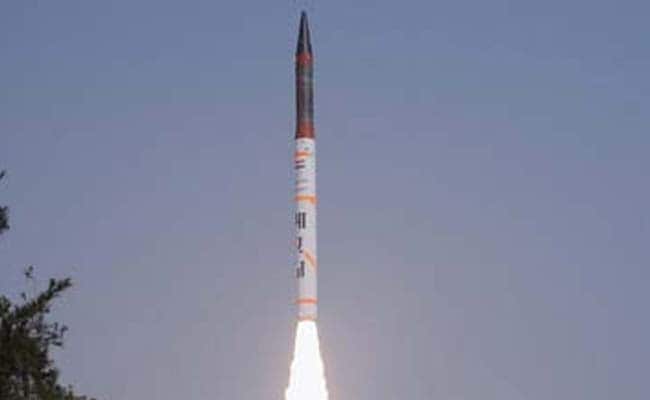
Medium Range Ballistic Missile ‘Agni-4’ was successfully test-fired from the Integrated Test Range, Chandipur in Odisha on August 06, 2026. The launch validated all operational and technical parameters.
The test was carried out under the aegis of the Strategic Forces Command.
Agni-IV is India’s advanced intermediate-range ballistic missile (IRBM), with a range of up to 4,000 km, designed to strengthen the country’s nuclear deterrence and strategic strike capability. It represents a major leap in missile technology, incorporating modern avionics, composite rocket motors, and highly accurate guidance systems.
Development and Background
- Origins: Initially conceived as Agni-II Prime, the Agni-IV was developed by the Defence Research and Development Organisation (DRDO) in the late 2000s.
- First Test: Conducted on December 10, 2010, but failed due to a control system error. Subsequent trials from 2011 onwards proved successful.
- Significance: The missile was a stepping stone toward the development of longer-range systems like Agni-V, showcasing India’s ability to field reliable, road-mobile nuclear-capable missiles.
Technical Specifications
- Type: Intermediate-Range Ballistic Missile (IRBM)
- Range: 3,000–4,000 km, capable of striking deep into Asia, including most of mainland China.
- Weight & Size: Launch weight ~17,000 kg; length ~20 meters.
- Warhead: Can carry nuclear or conventional payloads up to 800–1,000 kg.
- Propulsion: Two-stage solid-fuel composite rocket motor, lighter and more efficient than earlier Agni variants.
- Guidance: Equipped with Ring Laser Gyroscope (RLG) INS, Micro Inertial Navigation System (MINGS), and digital control systems, ensuring <100 m CEP accuracy.
- Launch Platform: Road-mobile 8×8 transporter erector launcher, enhancing survivability and mobility.
Test History
- 2011 (Odisha): Successful test, missile reached 900 km altitude and hit target in Bay of Bengal.
- 2012–2014: Multiple successful trials, including live payload tests with high accuracy.
- 2014 onwards: Strategic Forces Command (SFC) user trials confirmed operational reliability.
Strategic Importance
- Deterrence Role: With its 4,000 km range, Agni-IV bridges the gap between medium-range Agni-II and long-range Agni-V, giving India flexible strike options.
- Regional Impact: Provides credible deterrence against adversaries like China, covering strategic targets from northeastern India.
- Technological Leap: Introduced composite rocket motors, advanced avionics, and redundant navigation systems, paving the way for future hypersonic and MIRV-capable missiles.
Risks and Challenges
- Escalation: Enhances India’s deterrence but may fuel regional arms competition.
- Reliability: Early failures highlighted the complexity of advanced guidance systems, though later tests proved successful.
- Dependence on Mobility: Road-mobile systems require robust infrastructure and constant readiness.
In summary, Agni-IV is a cornerstone of India’s missile arsenal—combining mobility, precision, and extended range to reinforce national security and strategic deterrence. It stands as a technological bridge between India’s medium-range and intercontinental ambitions, ensuring credible second-strike capability in the Indo-Pacific theatre.
Medium Range Ballistic Missile ‘Agni-4’ was successfully test-fired from the Integrated Test Range, Chandipur in Odisha on August 06, 2026. The launch validated all operational and technical parameters.
The test was carried out under the aegis of the Strategic Forces Command.
Agni-IV is India’s advanced intermediate-range ballistic missile (IRBM), with a range of up to 4,000 km, designed to strengthen the country’s nuclear deterrence and strategic strike capability. It represents a major leap in missile technology, incorporating modern avionics, composite rocket motors, and highly accurate guidance systems.
Development and Background
- Origins: Initially conceived as Agni-II Prime, the Agni-IV was developed by the Defence Research and Development Organisation (DRDO) in the late 2000s.
- First Test: Conducted on December 10, 2010, but failed due to a control system error. Subsequent trials from 2011 onwards proved successful.
- Significance: The missile was a stepping stone toward the development of longer-range systems like Agni-V, showcasing India’s ability to field reliable, road-mobile nuclear-capable missiles.
Technical Specifications
- Type: Intermediate-Range Ballistic Missile (IRBM)
- Range: 3,000–4,000 km, capable of striking deep into Asia, including most of mainland China.
- Weight & Size: Launch weight ~17,000 kg; length ~20 meters.
- Warhead: Can carry nuclear or conventional payloads up to 800–1,000 kg.
- Propulsion: Two-stage solid-fuel composite rocket motor, lighter and more efficient than earlier Agni variants.
- Guidance: Equipped with Ring Laser Gyroscope (RLG) INS, Micro Inertial Navigation System (MINGS), and digital control systems, ensuring <100 m CEP accuracy.
- Launch Platform: Road-mobile 8×8 transporter erector launcher, enhancing survivability and mobility.
Test History
- 2011 (Odisha): Successful test, missile reached 900 km altitude and hit target in Bay of Bengal.
- 2012–2014: Multiple successful trials, including live payload tests with high accuracy.
- 2014 onwards: Strategic Forces Command (SFC) user trials confirmed operational reliability.
Strategic Importance
- Deterrence Role: With its 4,000 km range, Agni-IV bridges the gap between medium-range Agni-II and long-range Agni-V, giving India flexible strike options.
- Regional Impact: Provides credible deterrence against adversaries like China, covering strategic targets from northeastern India.
- Technological Leap: Introduced composite rocket motors, advanced avionics, and redundant navigation systems, paving the way for future hypersonic and MIRV-capable missiles.
Risks and Challenges
- Escalation: Enhances India’s deterrence but may fuel regional arms competition.
- Reliability: Early failures highlighted the complexity of advanced guidance systems, though later tests proved successful.
- Dependence on Mobility: Road-mobile systems require robust infrastructure and constant readiness.
In summary, Agni-IV is a cornerstone of India’s missile arsenal—combining mobility, precision, and extended range to reinforce national security and strategic deterrence. It stands as a technological bridge between India’s medium-range and intercontinental ambitions, ensuring credible second-strike capability in the Indo-Pacific theatre.